
7 May 2026
How to Use a Reef Tank Isolation Box for New Fish
Learn how an in-display fish acclimation box supports supervised introductions, how long to use one and why it does not replace quarantine.
The Challenge of Adding New Inhabitants
Introducing new inhabitants to a reef tank is always exciting — but risky. Territorial fins can flare, fights may erupt, and stress can sink even the boldest fish or coral. Whether it's a new clownfish pair, a delicate wrasse, or a prized coral frag, the first few days in a new tank are critical.
Traditional approaches range from "hope for the best" (toss them in and cross your fingers) to DIY plastic containers with holes drilled in them. Neither is ideal. The first risks injury or death, and the second looks terrible and restricts water flow.
Enter The Crew's Quarters
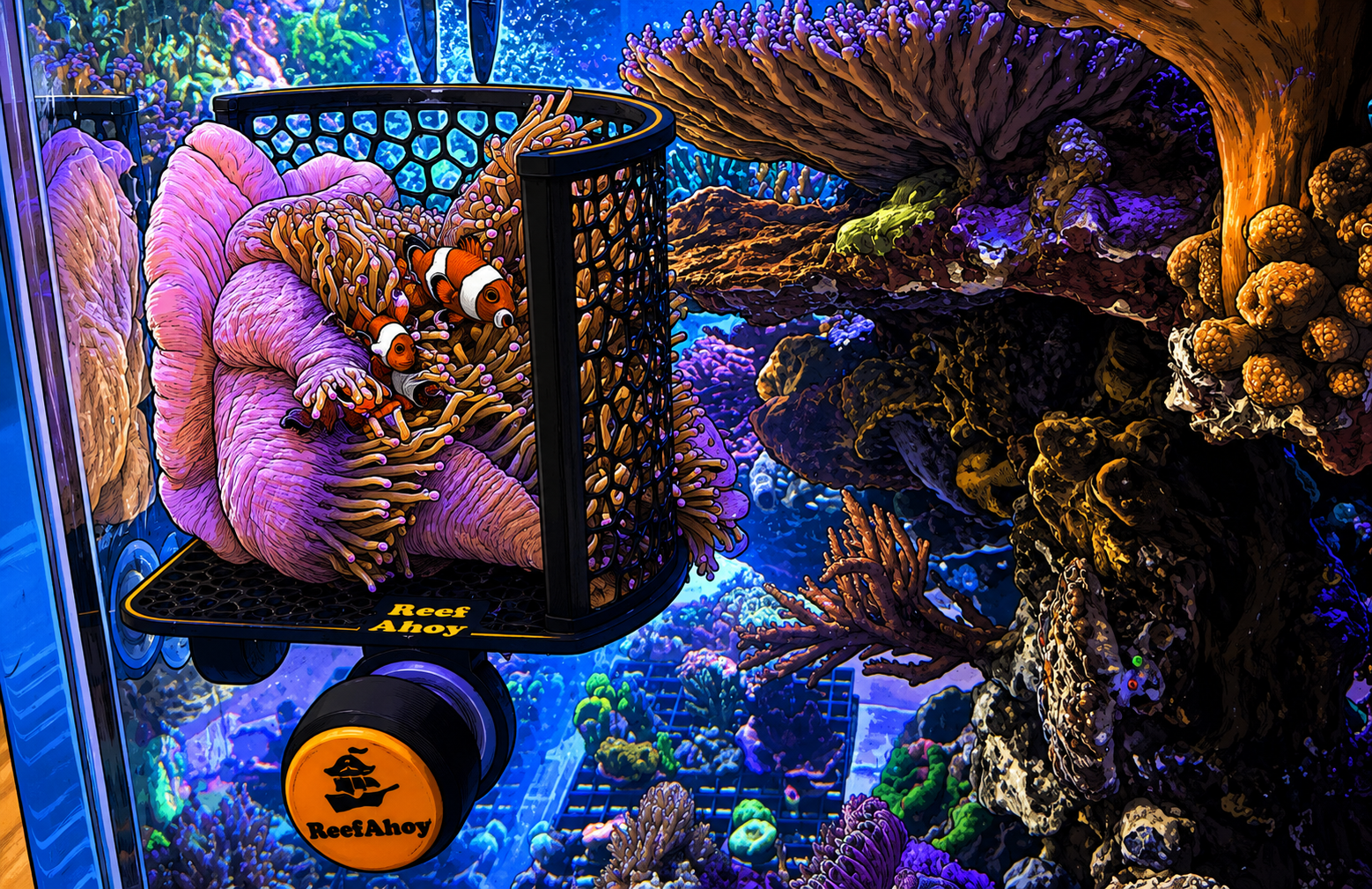
We designed The Crew's Quarters as a purpose-built isolation and acclimation system for reef tanks. It's 3D-printed from reef-safe PETG, designed to sit inside your display tank while keeping new arrivals safely separated from existing inhabitants.
Why Isolation Matters
- Territorial aggression — Established fish don't appreciate newcomers invading their space. An isolation period lets everyone get used to seeing each other before direct contact.
- Temporary separation — A physical barrier can prevent immediate contact while you observe swimming, feeding and interactions with established fish.
- Supervised observation — You can watch feeding, swimming and interactions while the animal remains physically separated. Because the box shares display water, it does not prevent disease transmission.
- Coral acclimation — New corals can adjust to your lighting and flow conditions in a controlled area before being placed permanently.
How It Works
- Position the enclosure — Place The Crew's Quarters in a suitable aquarium corner with clear water flow and enough room for the animal.
- Add your new arrival — Place the fish or coral inside the enclosure.
- Water flows freely — The perforated design allows full water exchange, so your new inhabitant shares the same temperature, salinity, and chemistry as the main tank.
- Assess before release — Monitor the animal's condition, feeding response and the behaviour of established livestock. There is no universal release schedule.
Design Considerations
When we designed The Crew's Quarters, we focused on a few key principles:
- Maximum water flow — Generous perforations ensure excellent water circulation. No stagnant pockets.
- Clean aesthetics — It's designed to look good in your display tank, not like a bodgy DIY job.
- Reef-safe materials — Printed in PETG that's been tested and proven safe for aquarium use. No leaching, no worries.
- Custom sizing — Custom sizing is available on request; confirm that the enclosure provides adequate room for the intended livestock.
Real-World Results
We use The Crew's Quarters to observe new arrivals and interactions with established livestock before considering release into the display.
It's also been invaluable for coral recovery. We've used it to protect damaged frags from fish picking at them while they heal.
Give Your New Crew Mates a Fighting Chance
Every reef keeper knows the heartbreak of losing a new addition in the first few days. The Crew's Quarters gives your new arrivals the best possible start in their new home.
Browse the shop to find the right size for your tank, or get in touch if you need a custom size.
Isolation box versus quarantine tank
These tools are not interchangeable. An in-display isolation box provides a physical barrier, but water still moves between the enclosure and the aquarium. It cannot prevent waterborne pathogens or parasites from reaching the display.
A quarantine tank is a separate system used for quarantine protocols, independent observation and treatment when appropriate. Use a quarantine process suited to your livestock and risk-management approach before the animal enters the display system.
How long should a fish stay in an acclimation box?
There is no fixed duration that works for every species or social situation. Monitor:
- whether the new fish is swimming and resting normally;
- whether it accepts appropriate food;
- whether established fish show persistent aggression;
- whether the enclosure provides adequate room and flow; and
- whether the animal shows distress, injury or abnormal behaviour.
Release should follow an assessment of the animal and the display tank, not an arbitrary number of days. If aggression or distress continues, reassess the introduction plan rather than extending confinement indefinitely.
Choosing and positioning an isolation box
The animal should be able to turn, rest and maintain normal posture without contacting the enclosure. Position the box where water can move through it and where the animal is not exposed to unsuitable light, flow or constant harassment.
The Crew's Quarters is corner-mounted, uses the aquarium glass as part of the enclosure and is available with custom sizing on request. It is designed for fish, coral and anemones, but each use still requires appropriate space, supervision and husbandry.
Is it a breeding box?
An isolation enclosure should not automatically be treated as a breeding box, nursery or long-term habitat. Breeding and rearing may require species-specific flow, screening, feeding access, dimensions and protection for eggs or larvae. Assess those needs separately.
Cleaning between uses
Remove the enclosure when it is no longer required. Rinse away detritus and algae, clean with a soft brush where needed and avoid household chemicals. Inspect the enclosure and confirm that the open-flow areas are clear before reuse.
Browse the Isolation & Acclimation collection, learn about our reef-safe materials, or contact us about custom sizing.